Software product development is the mainstay of innovation in the rapidly changing digital era of 2025, which is the reason why businesses can survive in the face of continual technological changes. As firms use digital transformation solutions, a deal with a trustworthy software product development by reliable software development company is not a matter of choice anymore. It is a must.
This ultimate manual unravels the route from the raw idea to the finished product in the market. Thus, it reveals how custom solutions and AI-powered app development software play a crucial role in gaining a competitive advantage..
The worldwide software development services market is worth $570 billion in 2025 and is forecasting to surpass $1 trillion by 2030.
However, knowing this process is crucial because it’s like having leaders hold the key. To a product design strategy for growth that lasts.
What Is Software Product Development and Why Is It Crucial in 2025?
Software product development involves the entire lifecycle of creating digital solutions to address everyday problems, from concept through release and subsequent iterations.
In 2025, it becomes critical. Because the primary driver of digital transformation solutions is their acceleration. Companies that use comprehensive custom software development services experience 20-30% faster time-to-market. And up to 25% cost reductions, according to industry benchmark studies.
Therefore, to stay unaffected by the increasing number of cyber threats (15% year-over-year). And to be well prepared for AI, which will likely disrupt 90% of enterprise workflows by 2028. They need custom software solutions.
For example, cloud integration services that effortlessly provide scalability, thus, companies will be able to manage a data increase that is growing at 50% annually.
The ones that do not give software product development a high priority are the ones who can be left behind very soon in an AI-driven world. Here, AI-powered app development accounts for 70% of new enterprise software development applications.
How Does the Software Product Development Lifecycle Work?
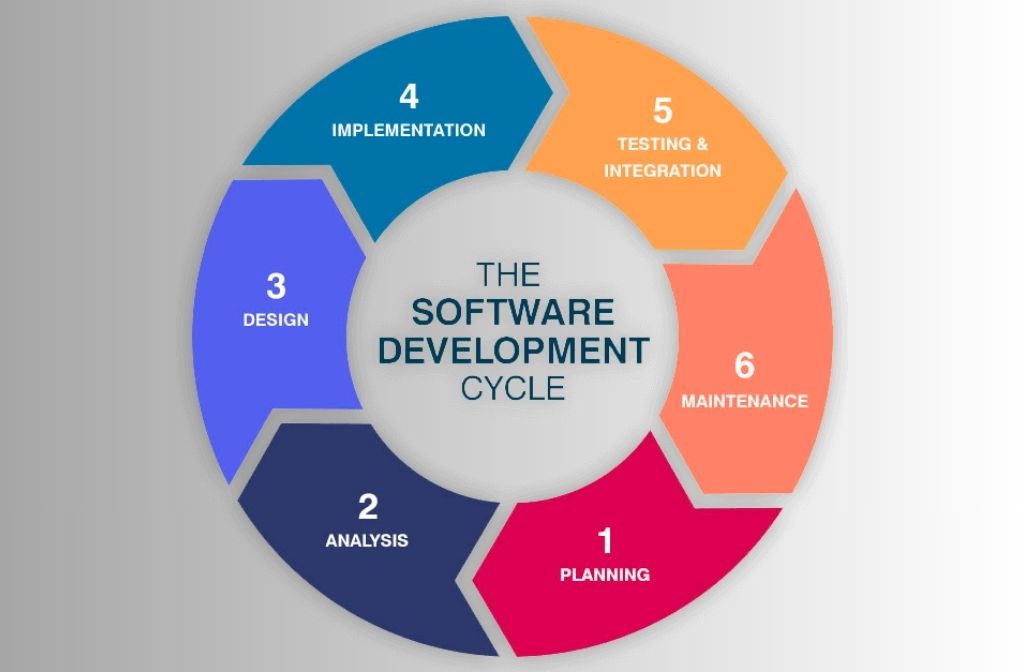
The software product development lifecycle (SDLC) is a defined framework that shows the way a team works from the initial phase up to the support that goes beyond the whole process.
Also Check this blog in details about latest innovations in software solutions.
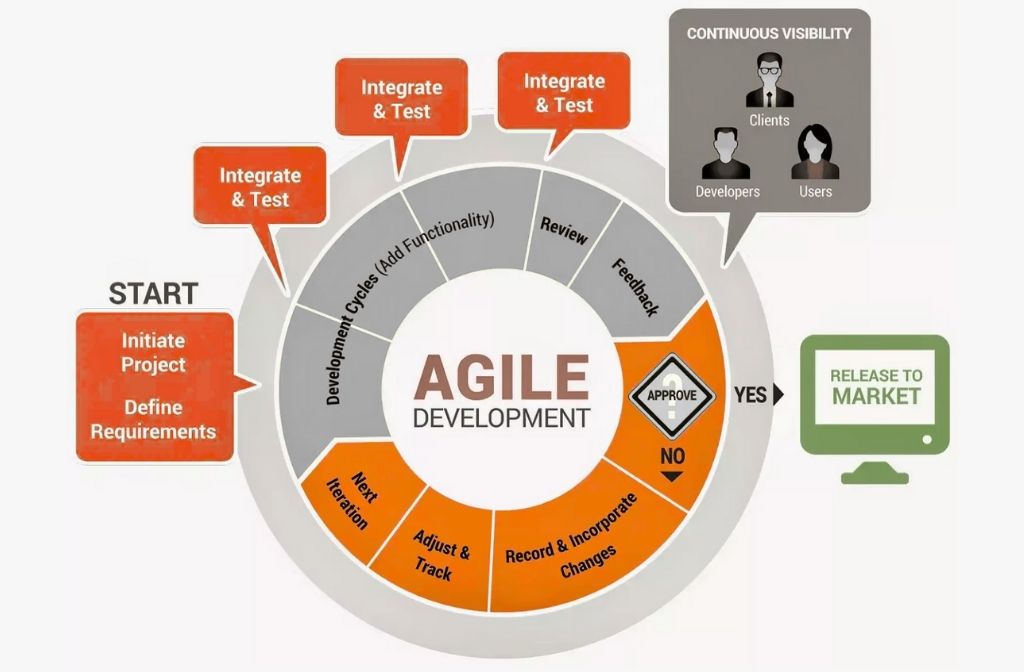
By the year 2025, agile methodologies will be the main choice. And therefore 71% of the organizations will be using them for faster iterations.
The main stages are preparation (market research), design (UI/UX prototyping), development (coding with AI tools), testing (automated QA), deployment (cloud computing rollout), and maintenance (post-launch updates).
This iterative loop, which is supporting by API integration, is responsible for the reduction of bugs by 40%. And the increase in release speed. In the case of SaaS development. It is a guarantee that subscription models will change along with the user feedback. Thus retention will be increased by 35%.
Also tread this blog also mobile app development software for innovative startups.
What Are the Key Stages in Turning an Idea Into a Software Product?
It takes six key phases to change an idea into a piece of software that can be sold, with each phase being a product design strategy to keep the alignment with the user’s needs.
- Ideation and Planning: Confirm the ideas through market analysis. AI-driven surveys are tools that can help to locate gaps, “with 65% of successful products coming from data-backed ideas.”
- Requirements Gathering: Feature definition through stakeholder input. Low-code / no-code platforms are 50% faster in this process, thus opening the way for more people to have their say.
- Design and Prototyping: Prepare wireframes and MVPs. A product design strategy here could include a microservices architecture for flexibility
- Development: Implement the core functionality using machine learning (ML) for adding smart features. AI-powered app development is 30% faster because it automates the coding part of the work.
- Testing and QA teams perform thorough inspections using automated suites to ensure data security and compliance, detecting 80% of vulnerabilities at an early stage.
- Deployment and Launch: Use cloud integration services for the rollout, and then monitor for the next versions.
A top software development company can minimize risks and maximize ROI by following such a phased approach.
Which Technologies Are Shaping Software Product Development in 2025?
The software product development environment in 2025 has changed radically with new technologies, with AI being the leading one at 60% adoption rates, particularly influencing innovations like medical billing software .
Machine learning (ML) has been the main enabler of predictive analytics, which has resulted in a 40% increase in the personalization of applications.
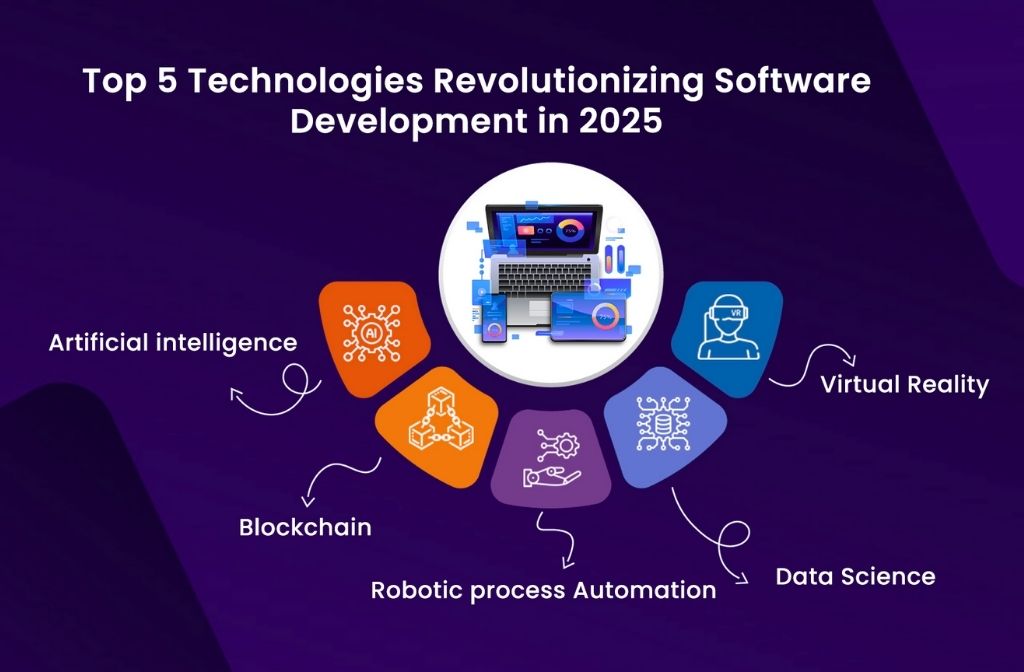
Cloud computing supports 85% of deployments, giving SaaS development the flexibility it needs. DevOps practices simplify CI/CD pipelines and reduce deployment times by 66%.
The company enhances connectivity through API integration, while low-code and no-code platforms empower non-coders, increasing the overall talent pool by 25%.
By breaking down monoliths into flexible components, microservices architecture encourages scalability. Data security and compliance tools, such as zero-trust models, handle growing security breaches.
Here is a comparative table of important technologies to show adoption trends:
| Technology | Adoption Rate (2025) | Key Benefit | Use Case Example |
| Artificial Intelligence (AI) | 60% | Automates 30% of coding | Predictive maintenance apps |
| Machine Learning (ML) | 55% | Enhances personalization by 40% | Recommendation engines |
| Cloud Computing | 85% | Reduces costs by 20-30% | Scalable SaaS development |
| DevOps | 70% | Speeds deployments by 66% | CI/CD for custom software solutions |
| Low-Code / No-Code Platforms | 45% | Accelerates prototyping by 50% | Rapid MVP building |
This table shows how these tools work together to deliver effective software development services.
For a graphic forecast of AI’s growth in the software development industry:
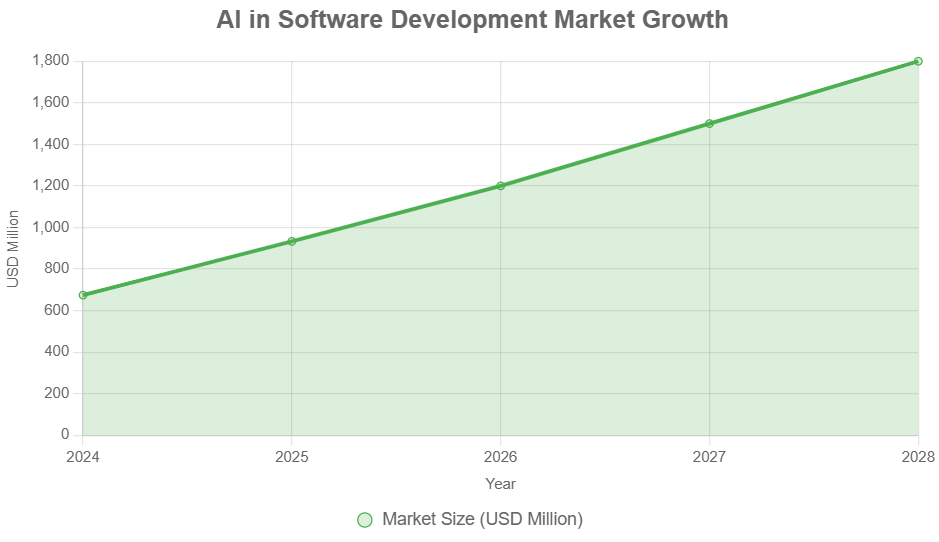
Forecasts indicate exponential growth, highlighting the critical role of AI.
How Can Businesses Build Scalable and Secure Software Products?
Producing software products that are both scalable and secure requires careful planning of the architecture. Use a microservices architecture to scale horizontally, thus being able to handle 10x traffic spikes without a drop in service. Integration of the cloud through services on AWS or Azure brings about auto-scaling, which is responsible for a 25% reduction in infrastructure costs.
Businesses that collaborate with proficient software development companies reach 99.9% uptime, thereby making scalability a source of revenue. How to hire software developer for startup in Chicago complete guide
Common Challenges in Software Product Development and How to Overcome Them
While the software product development has substantially progressed over the years. The industry still faces challenges such as a lack of skilled talent — reported by 45% of companies — and difficulties in integration.
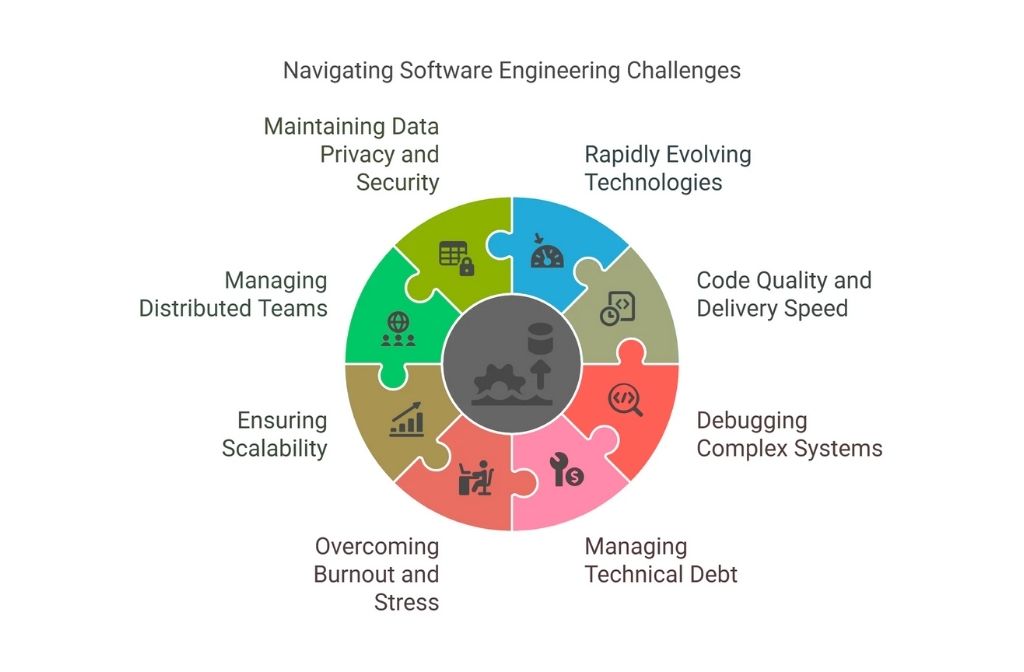
And an increase in cyber risks (by 15%). Scope creep affects 52% of projects, causing their launches to be delayed by several months.
Teams solve these problems by using DevOps to improve collaboration, increasing efficiency by 20%, and by adopting low-code platforms to enhance skills. They also implement AI-driven threat detection, which eliminates 70% of vulnerabilities and strengthens overall security. Also read this blog in detail.
There is a concise comparison table of challenges and solutions.
| Challenge | Impact (2025) | Solution Strategy | Expected ROI |
| Talent Shortage | 45% adoption delay | Low-Code / No-Code Platforms | 25% faster hiring |
| Cybersecurity Threats | 15% breach increase | Data Security & Compliance Tools | 40% risk reduction |
| Integration Complexity | 30% project overrun | API Integration & Microservices | 35% cost savings |
| Scope Creep | 52% timeline slip | Agile Product Design Strategy | 20% on-time delivery boost |
These methods, which are based on the advantages of DevOps, enable robust development.
What Does the Future Hold for Software Product Development?
By 2028, AI will orchestrate software product development, with 90% of engineers using code assistants. Most computing will occur at the edge and be protected by quantum-resistant encryption. Check this blog in detail also.
While SaaS development will evolve through AI-native platforms. The use of cloud computing will reach 90%, enabling hybrid models.
One of the main factors behind the implementation of “green coding” practices is the goal of cutting the carbon footprint by 30% through the use of efficient algorithms.
AI-powered app development will deliver highly personalized experiences at scale, driving the market toward an estimated value of $4.8 trillion by 2033. The future belongs to those who can adapt, are ethical, and are innovators.
Why Apps Cre8ve is the Ultimate Choice for Software Product Development?
Apps Cre8ve stands out as a leader in custom software development and is highly proficient in delivering custom software development solutions and AI-powered app development.
We have achieved a total of 200+ projects with a 98% positive response from clients. AI and cloud integration services strengthen our product design approach, enabling distinct and impactful outcomes.
We are experts in DevOps and microservices architecture. Thus, we assure that your launches will be scalable and secure. While the development time will be reduced by 40%. Take the risk with Apps Cre8ve to get innovative digital transformation solutions that will advance your dream.
Signing Off:
Apps Cre8ve stands out as a leader in software development and is highly proficient in delivering custom software solutions and AI-powered app development. Businesses that effectively manage product lifecycles, adopt the right technologies, and overcome challenges can introduce durable products to the market.. Work together with experts in software development services to maintain your procedures current for the future.
Frequently Asked Questions & Discussions
Q: How much will software product development cost on average in 2025?
A: Depending on complexity and features like AI-powered app development, MVP costs can range from $50,000 to $500,000. This can be cut by 30% with low-code platforms and scalable custom software solutions.
Q: How much time does it take to create a software product?
A: Most of the time 3-12 months, DevOps and cloud integration services are used to accelerate it for faster iterations.
Q: Are AI tools taking over the software developers in 2025?
A: No, not really. AI helps to enhance roles, and 90% of engineers use AI assistants to be more efficient.
Q: What function does cloud computing serve in modern software development?
A: This is the main reason that 85% of deployments are powered by it, as it provides data security and compliance together with scalability.
Q: How do small businesses manage to pay for custom software solutions?
A: We offer phased payments through SaaS development models and partnerships with software development companies.
Q: What will be the leading trends for software security in 2025?
A: The main focus will be on zero-trust architectures and AI-driven monitoring to fight increasing threats.
Leave a Reply